


 Sonder Bikes

Fleece and midlayers: how to choose one for the hills
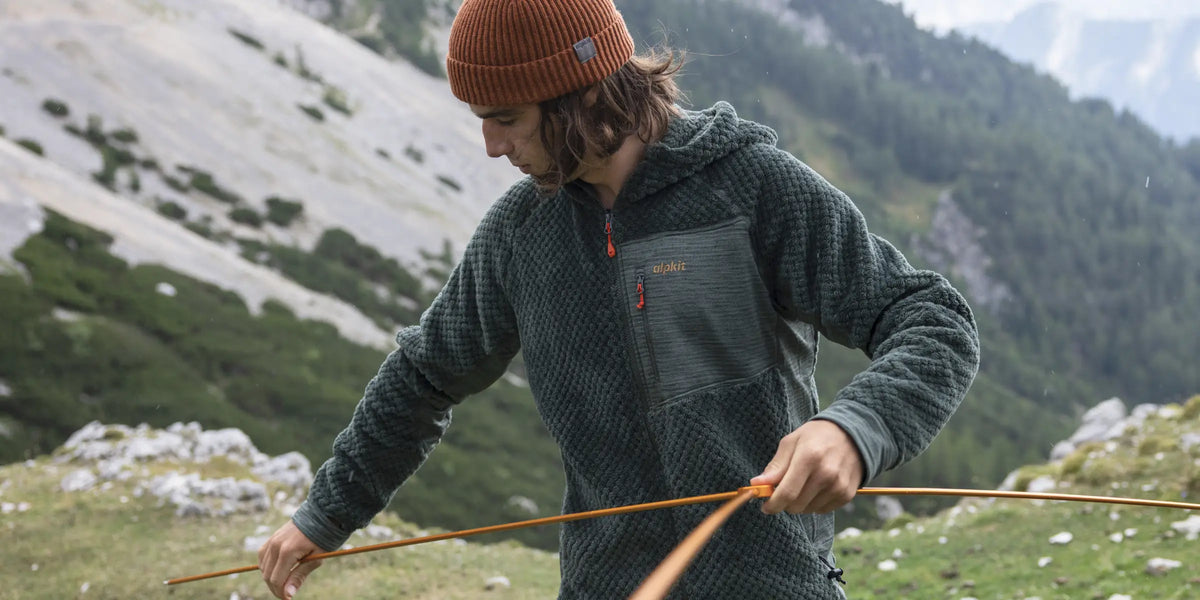



A midlayer keeps you warm between your base layer and waterproof. How fleece works, when wool is better, which weight suits you and the fleeces we make.
A midlayer is the layer between your base layer and your waterproof. Its job is to hold warm air around you while letting sweat escape, so you can stay warm on the move and add or take it off as the day changes.
Fleece is the most common midlayer. It's light, keeps much of its warmth when damp, dries fast and breathes well. Wool is the natural alternative: warm when damp and slow to smell, but heavier and slower to dry. For cold, still days you'd add an insulated jacket on top, and when you're moving hard in the cold, a breathable active-insulation jacket can do the midlayer's job too.
In this guide
Your base layer deals with sweat next to your skin. Your waterproof keeps out wind and rain. The midlayer sits in between and does most of the work of keeping you warm.
A good midlayer traps air but still breathes, so the sweat your base layer moves away can carry on out through your clothes. If it doesn't breathe, you overheat on the climb and then get cold when you stop.
"Fleece or midlayer" isn't really a choice. Fleece is one type of midlayer. The others are wool jumpers, thin insulated jackets and softshells. Fleece is the most popular because it does the job well for most people, most of the time. See how the layering system works for how the layers fit together.
Fleece is a knitted polyester fabric that's brushed or knitted to raise a soft pile on one or both sides. The pile traps small pockets of still air, which is what keeps you warm.
Polyester barely absorbs water, so fleece keeps much of its warmth when damp and dries quickly. It's also breathable: sweat vapour passes through the open structure easily. The flip side is wind. The same open structure lets wind straight through, which is why a standard fleece feels cold on an exposed ridge unless you put a shell over it.
How a fleece is knitted changes how warm it is, how well it breathes and how it feels.
Grid fleece has a waffle pattern of channels on the inside. The raised squares trap warmth, and the channels let heat and sweat escape, so it's warm for its weight and very breathable. Griffon is our grid fleece, for active days.
Microfleece is thin and smooth with a short pile. It's light, packs small and layers easily under a waterproof. Kelpie is our classic microfleece.
High-loft fleece has long, fluffy fibres in an open knit. It gives a lot of warmth for its weight and breathes well, but needs a shell over it in any wind. Keeshond uses it.
Pile fleece (sometimes called sherpa) is thick and furry, for cold days, camp and winter. Sastrugi is our pile fleece.
Wind-resistant fleece has a dense outer face, or a windproof layer bonded inside, so it can be worn on its own in a breeze. Yakutian has a dense-knit face; Mamalute is fully windproof.
Fleece is often described by fabric weight in grams per square metre (gsm). It's a rough guide to warmth:
The weight isn't the whole story. A grid or high-loft fleece can be warmer than its weight suggests because of how much air its structure traps, so compare weights between fleeces of the same type.
Both make good midlayers. They suit different days.
| Fleece | Wool | |
|---|---|---|
| Warmth when damp | Keeps much of it, dries fast | Keeps much of it, dries slowly |
| Weight and pack size | Lighter, packs smaller | Heavier, bulkier |
| Smell after a few days | Builds up, less with an anti-odour treatment | Very little |
| Breathability | Good, best in grid and high-loft | Good |
| Care | Machine wash, quick to dry | Gentle wash, dry flat |
| Cost | Costs less | Costs more |
Fleece suits active days and anything where weight and drying time matter. A wool jumper suits steadier walks, cold evenings at camp or in a bothy, and trips where you'll be wearing it for days. Wool blends and merino midlayers like Milford sit in between: lighter and softer than a chunky knit, with wool's resistance to smell. See why wool jumpers make great midlayers and our merino or synthetic base layer guide for how wool handles sweat.
You can, on dry days without much wind. A standard fleece breathes so well that a breeze goes straight through it, so on an exposed hill you'll want a windproof or waterproof on top.
If you want a fleece to wear on its own, choose one built to block wind. Yakutian's dense-knit outer face is roughly four times more wind-resistant than an average fleece, according to its product page, and it's tough enough for scrambling. Mamalute has a fully windproof layer bonded inside, which makes it a warm outer jacket for frosty walks and camp, but it breathes less, so it's not the one for working hard uphill.
Hillwalking. Changeable weather and a mix of climbing and stopping. A light to midweight fleece that breathes well and fits under your waterproof, like Kelpie or Griffon. Add an insulated jacket for long stops in the cold. Our hillwalking midlayer guide goes into more detail.
Winter walking and camping. Colder, with more standing around. A warmer fleece like Keeshond under a shell while you move, and Sastrugi or Mamalute at camp.
Running and cycling. Hard efforts and lots of sweat. A light, close-fitting fleece that breathes, like Griffon or Moya. See midlayers for trail runners and midlayers for cyclists.
Climbing and scrambling. Stop-start, with rock and harness. A stretchy, hard-wearing fleece like Yakutian, with pockets that sit above a harness.
Travel and everyday. One layer that looks fine in town and works on the hill. Loki, or a wool jumper like Norge or Pennine.
Fit. A midlayer should fit over your base layer and under your waterproof without bunching. Try it on with your waterproof over the top and reach up: a slim waterproof bought for summer can feel tight over a thicker fleece.
Zip. A full or half zip lets you vent heat on a climb without taking the layer off.
Hood. A close-fitting hood adds warmth around your neck and head, and should fit under a helmet if you climb or cycle. Leave it off if you'll mostly wear a hooded waterproof on top.
Thumb loops keep sleeves in place when you reach up or pull on a shell.
Pockets. Hand pockets set high can still be reached with a rucksack hip belt or climbing harness on.
Care. Wash fleece regularly with a mild detergent and let it air dry. Wool needs a gentler wash and drying flat. Some of our fleeces, like Griffon, have a Polygiene anti-odour treatment so you can wash them less.
Griffon: when you're moving fast and need to lose heat. Grid fleece that's warm for its weight and very breathable, with a Polygiene anti-odour treatment. 93% recycled polyester. Men's and women's.
Moya: when your pace changes all day. A fitted active fleece with a brushed inside for warmth and a smooth, hard-wearing outside, with stretch. For running, riding and fast hiking. Men's and women's.
Kelpie: when you want one fleece to throw in every pack. A light, fast-drying microfleece with a slightly relaxed fit that layers under a shell, made from 100% recycled fleece fabric. Men's and women's.
Loki: when you want a pull-on for the crag, the campsite and town. A lightweight, quick-drying fleece with a snap neck and kangaroo pocket, made with 100% recycled fabric. Men's and women's.
Keeshond: when you need more warmth but still want to move. High-loft fleece with grid panels under the arms to dump heat. Works under a shell in winter. Men's and women's.
Sastrugi: when it's properly cold and you're not moving much. 320gsm pile fleece, warm enough to wear as an outer layer on cold mornings and at winter camps. 100% recycled fabrics. Men's jacket and women's pullover.
Yakutian: when the wind picks up and your shell is in the pack. Dense-knit, wind-resistant face, four-way stretch and a soft inside. For scrambling, climbing and breezy walks. Men's and women's.
Mamalute: when you want a warm jacket that blocks the wind. Heavyweight brushed-back fleece with a fully windproof layer, hand-warmer pockets and a hood. For frosty walks and evenings around the tent. Men's and women's.
Wool jumpers: when you want natural warmth that doesn't smell. Pennine (women's) is made in the UK from undyed British lambswool, with a seamless knit that won't rub under pack straps. Norge is a half-zip in RWS-certified lambswool, and Stora a women's RWS wool jumper with raglan sleeves for easy movement. Brenin (women's), in merino, and Tryfan, in pure wool, are chunky, fitted knits inspired by 1950s and 60s North Wales climbing clothes.
Milford: when you want merino's comfort in a midlayer. 260gsm pure merino with a loop-back knit and button collar, smart enough for the pub. Men's and women's.
See all fleeces, midlayers and jumpers.
Next up in our series The Complete Guide to Outdoor Clothing: Things hot up as we insulate you from the cold with down and synthetic insulation.
Black Friday


Black Friday


Black Friday


Black Friday


Black Friday


Black Friday


Black Friday


Black Friday


Black Friday


Black Friday


Black Friday


Black Friday


