


 Sonder Bikes

B1 vs B2 Mountaineering Boots: Crampon Compatibility Explained
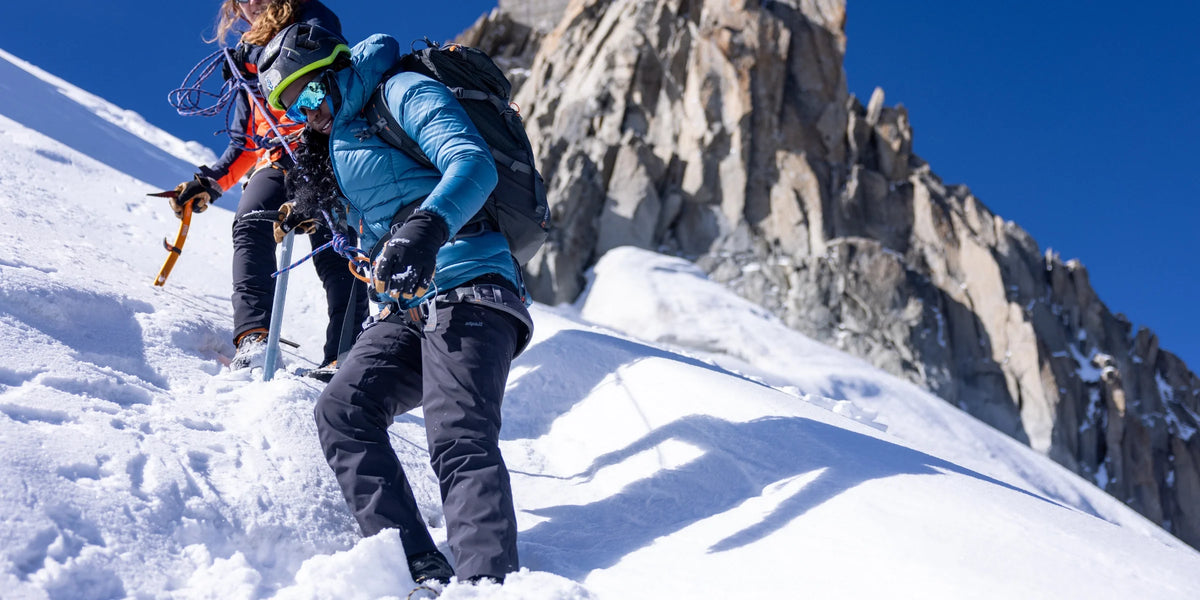



The B rating system determines which crampons your boot can safely use. Here's what each rating means and which one you need.
If you're heading into the Scottish hills in winter or planning any route that involves snow and ice, crampon compatibility is a question you can't afford to get wrong. The B rating system tells you what a boot can safely handle. Choosing the right rating isn't just a technical decision; it's a safety one. For more winter hillwalking advice, visit our hike-focused pages.
Boots are rated B0 through B3 based on sole stiffness and how they interact with crampon bindings. The higher the number, the stiffer the boot and the more technical the crampon it can safely accept.
B0: Flexible walking boots
Standard three-season walking boots with flexible soles. Not crampon compatible. Fine for dry and wet trails, but unsuitable for snow and ice use with crampons.
B1: Semi-stiff boots
A stiffer sole that takes C1 crampons only. Suitable for Scottish winter walking, general mountaineering on moderate terrain, and glacier travel. The most versatile winter category for hillwalkers.
B2: Stiff boots
A stiffer sole, usually with a welt at the heel, that takes C1 or C2 crampons. Suited to steeper snow, Grade I–II Scottish winter routes and most alpine mountaineering.
B3: Fully rigid boots
Designed for front-pointing on steep ice and technical mixed climbing. No flex in the sole at all. Takes C1, C2 or C3 crampons. Outside the scope of most hillwalkers and beyond the current Alpkit range.
Crampons use a matching C rating. Boot and crampon ratings must be compatible for safe use. Using mismatched combinations risks the crampon releasing under load.
| Boot Rating | Compatible Crampons | Typical Use |
|---|---|---|
| B0 | None | Trail walking, summer conditions |
| B1 | C1 (strap-on, flexible) | Scottish winter walking, moderate alpine |
| B2 | C1 or C2 | Technical winter routes, alpine climbing |
| B3 | C1, C2 or C3 | Steep ice, technical mixed climbing |
A C1 crampon is flexible, with straps or plastic cages at the toe and heel, so it fits a boot with no welts. A C2 crampon has a cage or strap at the toe and a clip-on lever at the heel, so it needs a boot with a heel welt. A C3 crampon is fully rigid, with a wire bail at the toe and a lever at the heel, so it needs welts at both the toe and the heel, as on a B3 boot.
A boot can take a crampon with a lower rating, but never a higher one: C1 fits any boot from B1 up, C2 fits B2 and B3, and C3 fits B3 only. Always check your crampons fit your boots before you head out.
For most Scottish winter hillwalking, a B1 boot is the right choice. It gives you crampon compatibility for icy paths and moderate snow slopes without the weight and stiffness of a full mountaineering boot.
Move up to B2 if you're planning routes that regularly involve Grade I or II terrain, narrow ridges in hard conditions, or any technical winter climbing. The additional stiffness is also better for front-pointing on steeper snow.
If you're unsure, B1 covers the vast majority of UK winter use cases. B2 is a specific tool for specific objectives.
Scottish winter grades run from Grade I (straightforward gully walking in good conditions) up to Grade IX and beyond (elite technical climbing). Crampons become relevant from Grade I upward when ice or hard snow is present.
For Munro bagging and winter hillwalking, take crampons and a boot rated B1 or stiffer, along with an ice axe and the skills to use them. Conditions on the hill change quickly, and a path that's only wet at the car park can be hard ice higher up.
See: Essential Winter Hill Walking Kit and What to Wear for the Scottish Winter Mountains
Microspikes, such as the Kahtoola MicroSpikes, are for icy ground in the lowlands: frozen towpaths, forest tracks and park trails. They stretch over most B0 walking boots and grip hard-packed snow and ice without needing a stiff sole.
They are not a substitute for crampons in the hills. On winter mountain ground, from steep snow to an iced-up path along a ridge, wear crampons on a rated boot.
The crampon-compatible boot in the range is the Montee: a B2-rated mountaineering boot with a split leather upper, Sympatex waterproof membrane, and Vibram XS Trek sole. Designed and developed in Italy and made in Romania to REACH standards, with a PFAS-free Sympatex membrane. Its heel welt takes C2 crampons with a heel clip, and C1 crampons fit too.